Why is it that we can understand exactly what we want to change in our lives, yet still struggle to actually change?
We can recognise the patterns that aren't serving us, understand where our beliefs come from and decide we want something different. But we tend to approach change through the conscious mind: we think, analyse, reflect and make plans. So much of how we experience the world happens beyond our awareness, and that's where I think it's worth looking.
How our patterns develop
From the moment we're born, we're learning about ourselves and the world. Early experiences shape our understanding of safety, relationships, belonging and self-worth, and a lot of this happens before we can consciously question it.
Theta brainwaves, which are slower-frequency waves, are particularly prominent in early childhood, a period when our brains are rapidly forming connections and foundational beliefs. It's worth keeping in mind, because we'll come back to it.
But this doesn't stop when we grow up. Through neuroplasticity, our brains keep forming new connections throughout life, and we keep developing beliefs and emotional associations through our relationships and environments. Many of these become automatic, influencing how we see ourselves and respond to situations without us realising.
So understanding intellectually that something needs to change doesn't mean our learned responses will change with it.
The nervous system's role in change
Imagine someone who grew up being criticised or dismissed whenever they spoke up. Over time, they may associate expressing themselves with rejection.
As an adult, they consciously want to be more visible, share opinions and set boundaries. But when they try, they hold back, question what they're saying and feel uncomfortable being seen. Their conscious mind wants something different, but their emotional and physiological responses haven't caught up.
Our experiences shape what feels familiar, and what we associate with safety or threat. When we challenge familiar patterns, our nervous system may respond with discomfort, heightened alertness or an urge to withdraw. That doesn't mean we're making the wrong decision. It may simply mean we're doing something our system hasn't learned to feel comfortable with yet.
This is why working with the nervous system matters. It isn't about eliminating fear. It's about gradually building the capacity to experience unfamiliar situations without automatically returning to old responses.
Breathwork: different practices for different needs
Breathwork isn't one single practice. Some approaches slow us down and support regulation, while others use more active breathing to facilitate deeper experiences and altered states of consciousness. Which one helps depends on what we're experiencing.
1. Grounding breathwork: creating a sense of safety
Sometimes what we need most isn't more intensity, but to slow down. If we're overwhelmed, activated or stuck in overthinking, more intensity isn't necessarily helpful.
Grounding breathwork helps us work with our physiological state, reconnect with our bodies and feel safer in the present moment. Someone becoming more visible might practise feeling grounded before, during and after putting themselves out there. Someone setting boundaries might learn to stay connected to themselves when others don't respond as hoped. Someone taking a new direction might learn to sit with uncertainty instead of retreating to what's familiar.
It's not about convincing ourselves everything is safe. It's about building the capacity to show up even when things feel unfamiliar.
2. Transformative breathwork: exploring deeper patterns
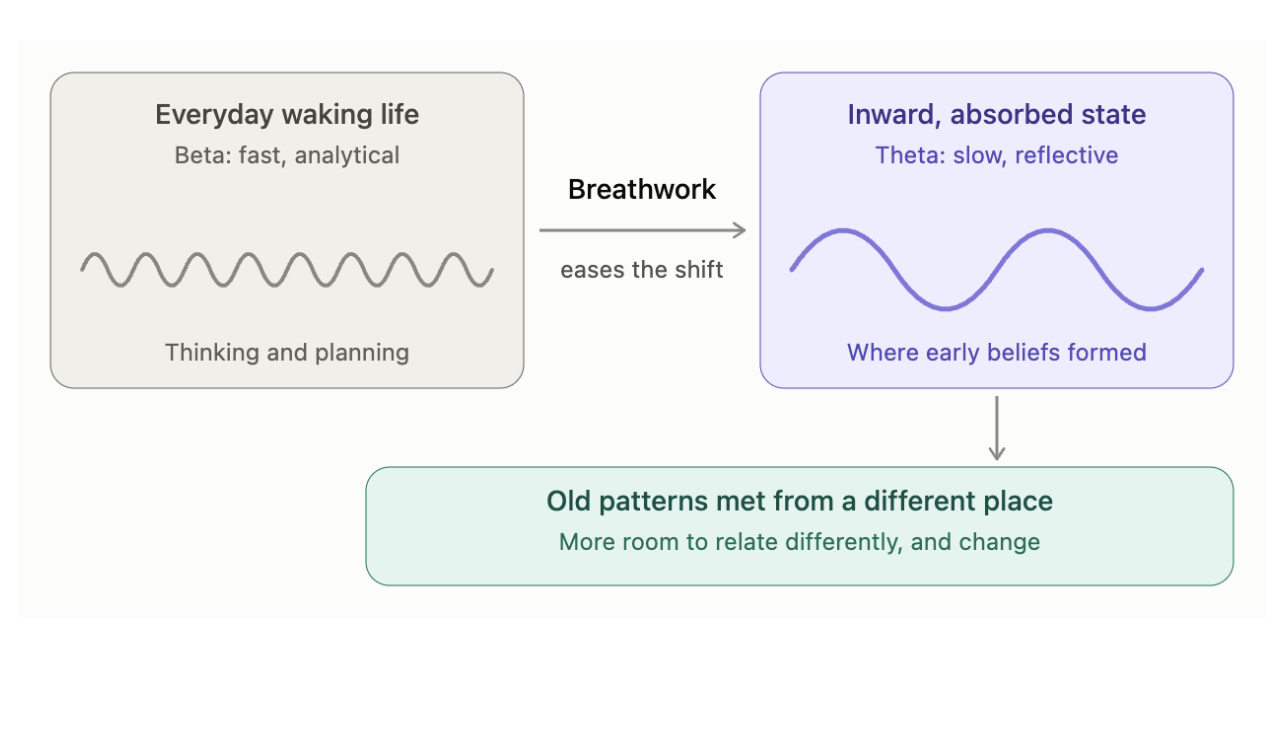
Transformative breathwork uses more active or sustained breathing to help us move out of our usual analytical mode and into a more inward, absorbed state. In early childhood, our brains spend a lot of time in slower theta activity, a period when many of our foundational beliefs formed. As adults, we spend most of our waking lives in faster, thinking-focused states. Practices like meditation and breathwork are associated with a shift toward slower activity, including theta, and many people find breathwork a more accessible way into that state than stillness alone.
In that space, emotions, memories and sensations may surface that are hard to reach through thinking. That gives us a chance to meet old patterns from a different place, rather than just analysing them.
An altered state doesn't automatically rewrite a belief or erase an old pattern. But combined with reflection and ongoing practice, it can become part of a broader process of change.
Sometimes grounding, sometimes transformation
No one type of breathwork is always better. If we're highly activated, we probably need more safety, not more intensity. If we're stuck repeating the same patterns and perspectives, a more transformative approach may help us relate to ourselves differently. Often we need both: to explore what's beneath the surface, and to build enough stability to live differently.
More intense doesn't mean more effective, either. Transformative breathwork isn't appropriate for everyone, and active breathing methods can have significant physiological effects, so the method, your circumstances and appropriate guidance all matter.
Change is something we experience
We can spend a lot of time understanding why we behave as we do. But creating change also means giving ourselves new experiences: building new associations, practising unfamiliar behaviours and gradually developing a different relationship with ourselves and the world.
Breathwork can help us regulate, reconnect, explore and become more aware of what's happening beneath the surface. But integration happens over time, through the choices we make and how we show up in everyday life.
Sometimes change starts with understanding something differently. Sometimes it starts with experiencing something differently. And often, it takes both.